
Week 7
Reading Reflection
Scott McCloud, Understanding Comics Ch 4
This chapter discusses some basic ways of expressing comics. I have always been interested in and consumed a lot of comics or similar art expressions like manga, and since I have seen a lot of them, I do sometimes feel the difference or evolution of comic expression when different comics are produced in different regions or different time periods. For example, as the author mentioned, the expression of motion in Japanese comics and European or American comics can differ in many ways; to me personally, I also felt like the use of panels can vary a lot, depending on the types of comics. For example, in Japanese manga, different stories, such as love, adventure, or horror, will make use of panels in a significantly different but respectively standardized way. Despite saying that, I have never paid much attention to the use of panels or motions in the past, just like how the author said, panels are often overlooked. I have never noticed these differences until the author mentioned them to me, and then I was like, “Oh…that’s true.”
Scott McCloud, Understanding Comics Ch 6
I really like how the author emphasizes that the combination of text and image is a traditional way of expression. I have always felt that simply using words is not enough to express things I feel. And I have always felt like I need to use both words and graphics - or hand gestures if it is in person - to fully express my mind or my feelings. To me, my “language”, or way of expression, lay in a position in the middle of the horizontal scale of the horizontal scale of words and pictures. Therefore, I really appreciate it when you answer checks back to history and prove to the audience that combining tax and graphics has always been a tradition. That makes me feel like I am not the only one.
Time Capsule: Object Prosthetic (Midterm)
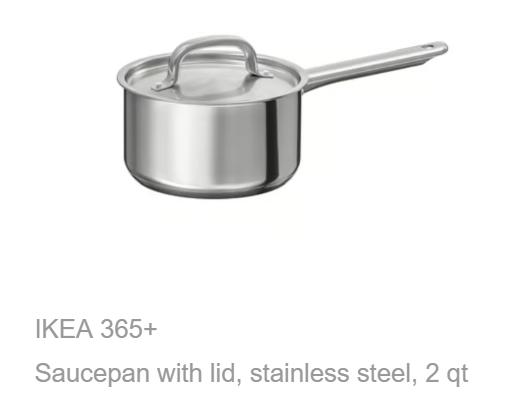
Object Choosing: Sauce Pan
Future Context:
For this project, we decided to design a society that is abundant in online information and scarce in physical interaction.
Today, people are overworking, skipping meals, and addicted to screen-related entertainments like video games and short videos, and many of them also lack physical activities, or in other words, “life in the real world”.
Not only does this occur in adults, but it also happens in the younger generation. Studies have already shown that children and adolescents are having more screen time and less physical activity. According to the article “Cross-sectional associations between screen time and the selected lifestyle behaviors in adolescents”, which studied 13,677 U.S. adolescents, more than half of them spend more than 2 hours on TV or video games every day, and 75.1% of participants get less than 60 minutes of physical activity every week (Fan et al., 2022).
Also, according to the study in U.S. Children Meeting Physical Activity, Screen Time, and Sleep Guidelines, only 32.9% of U.S. children and adolescents meet the screen time guideline of 2 hours or less of recreational screen time per day, and only 23% of them meet the physical activity guideline of 60 minutes or more per day (Friel et al., 2020).
Therefore, we pushed this situation to a more extreme extent in 2075. We predicted that later generations will be more addicted to screen entertainment and have much less or even no physical interaction. They will spend even more time working, and when they are off work, they spend all of their time online and interacting with technology. While there will be more high-end technologies, while the government controls people using tittytainments like short videos to stop them from critical thinking, people will have a more empty minds and become more like soulless robots. Their everyday life is totally controlled by technology, with little to no opportunity to live in the physical world.
We also combined the earlier idea from A World without Food, that as people are getting busier and busier at work, along with the lack of food resources and thus the extreme rise of food prices, ordinary people no longer have the time and cost to make food themselves and instead depend on pre-made food and supplements as energy and nutrition resources, and cooking food become a kind of luxury activity. Therefore, people in the later generations do not know how to use a saucepan, and many of them have not even seen a saucepan in their lives.
As a result, when a young person in 2075 finds a saucepan in a landfill, what are they going to do with it?
Ideation Development:
We did not want to see society turn out the way we imagined. Therefore, we reused the “junk” saucepan that will no longer be used in 2075 and altered it into a musical instrument toy. As people in 2075 will no longer have physical instruments, this will be something completely new for people in that society, and will this be the start of a disruption of society? We will wait and see.
We redesigned the saucepan into this toy to help people find the joy in simple physical, real-life entertainment and encourage people to unplug, live in reality, and live in the present.
Sketches & Prototype:
At the beginning, we decided to turn the saucepan into a drum, since the different parts of the saucepan have different textures and will make different sounds when being tapped. Therefore, we referred to the shape of a drum set and decided to 3d print a support stand that connects the saucepan lid to the saucepan body.

Drum Set (Source: internet)

Sketch 1. Turn the pot into a drum
Then, we decided to also incorporate elements of string instruments, as the hollow body of the pot resembles the resonance chamber that amplifies sound in string instruments.
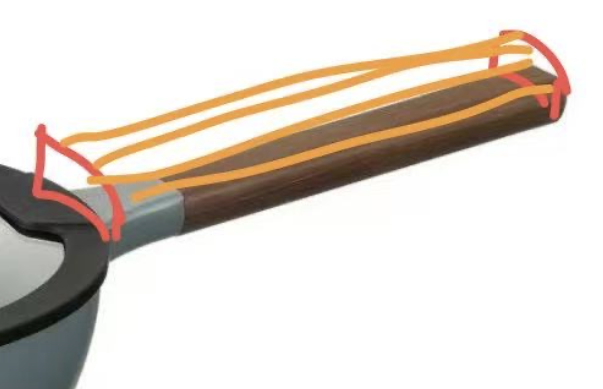
Sketch 2. Where could we put the strings
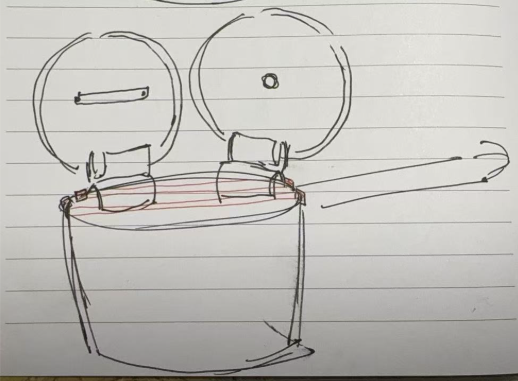
Sketch 3. A combination of drum pot and string pot
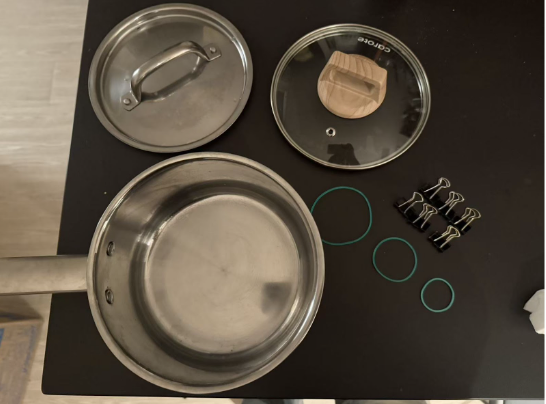
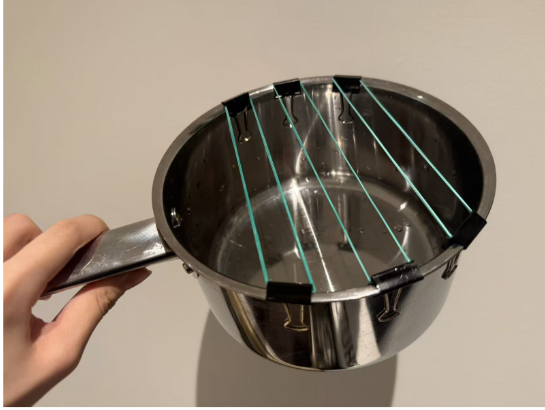
We used rubber bands as strings, and it worked!
3D Modeling & 3D Printing:
We wanted to 3D print a connector to connect the lid to the pot. The connector consists of two main sections—essentially two hollow rectangular forms joined together. The section attached to the pot is curved, and the inner cavity of the other section also needs a curved profile to match the original shape of the pot lid.
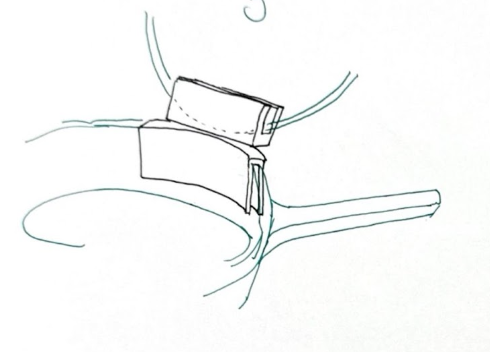
Sketch 4 A more detailed connector design sketch
Based on this idea, we made 3D modeling in Blender.
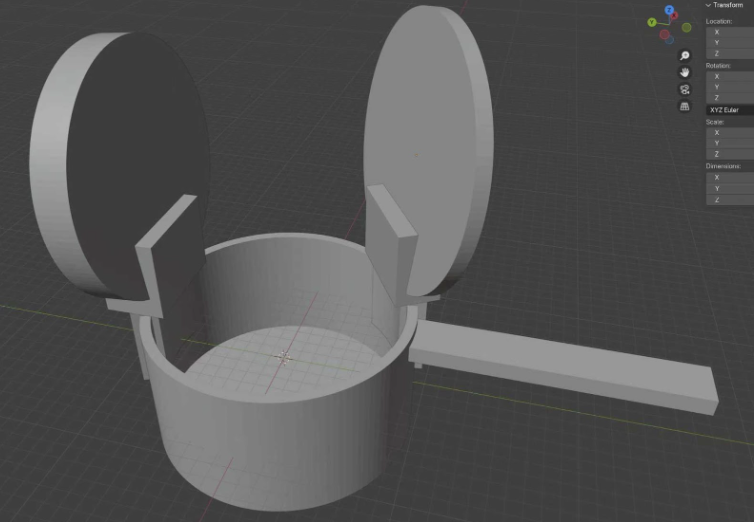
Model ver.1
This was our first prototype, but we found that the lids were so upright and weren't very aesthetically pleasing (nor a good drum to play with), and they also got in the way of plucking the strings. So we iterated it.
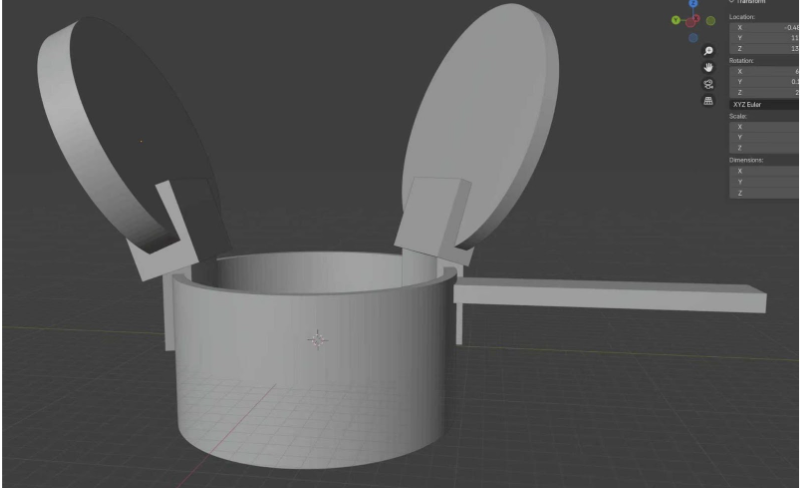
Model ver.2 (looked better!)
After the model is done, we sent it to the 3D printer. But our first try failed because we did not turn on the support.
And that is because 3D printing builds parts layer by layer, so there always has to be a previous layer to build upon. (Source: What are supports in 3D printing? When and why do you need them? | Protolabs Network)
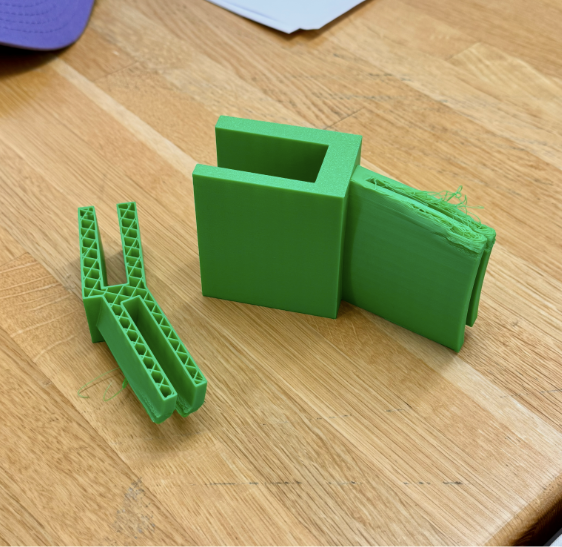
Oops! One part even stopped the printing progress in the middle because the machine detected something was not right.
Final Outcome:
And this is what we got!
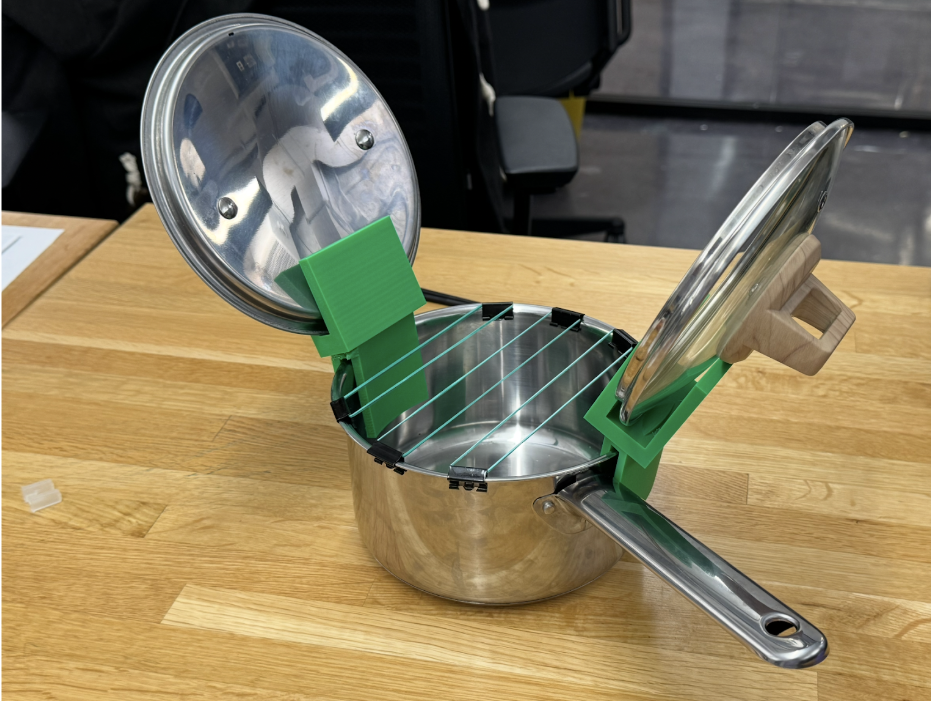
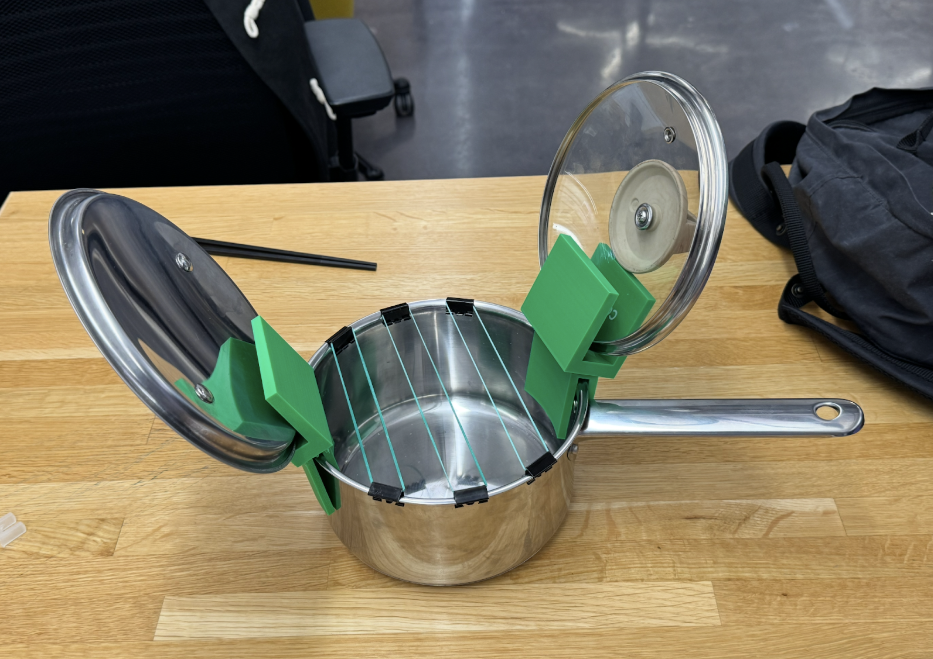
You can knock it or pluck the rubber band to make a sound.
